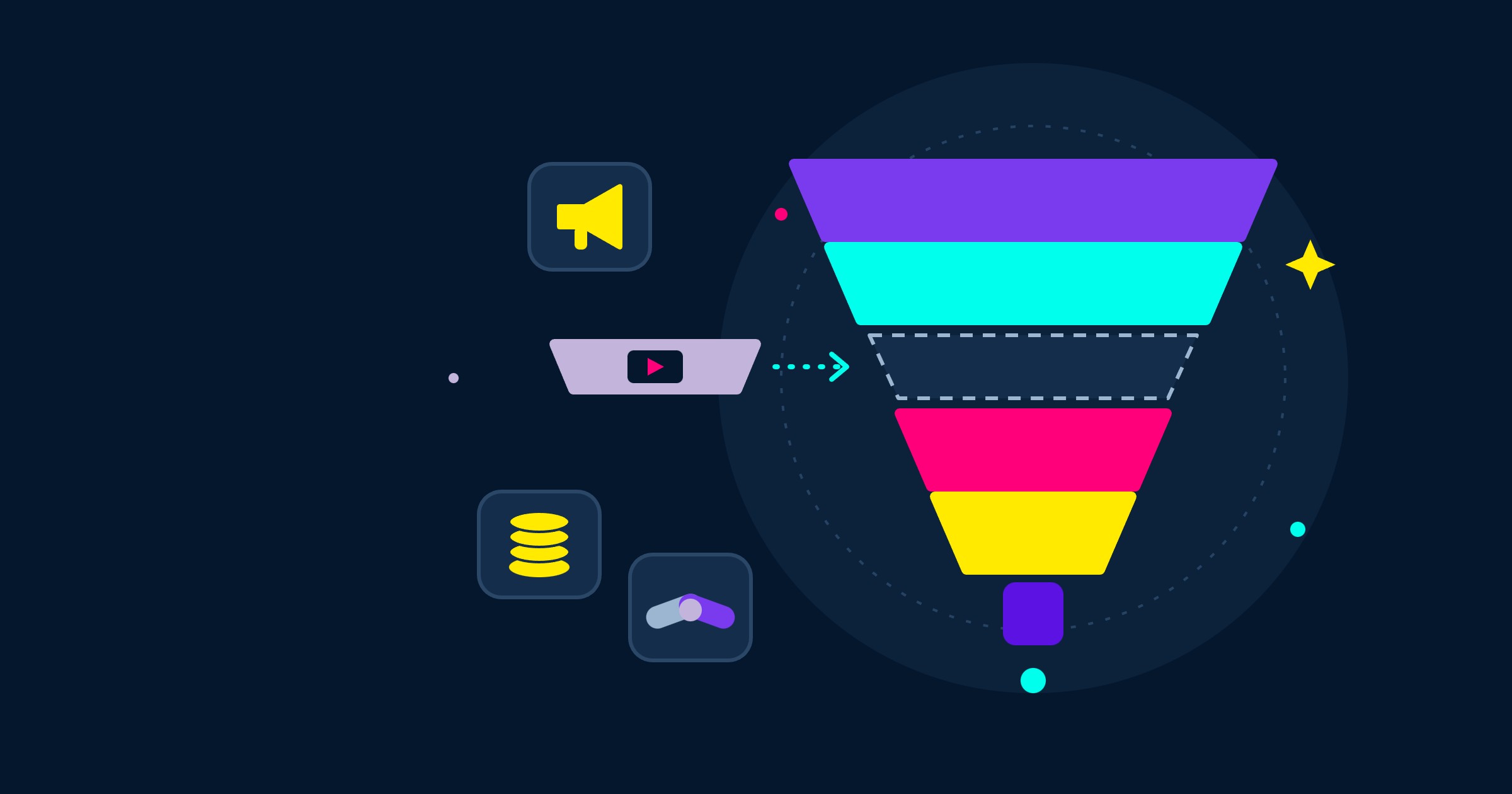
Most of the checklist in Gaming Marketing Agency Checklist applies to any size studio. The high level view on what you're buildign with all of that work is a marketing funnel. Each component has its own place: PR earns coverage and credibility, paid ads reach people who've already shown interest, and each creator platform, Twitch, YouTube, TikTok, Instagram, reach different portions of the marketing funnel. You need a reasonably complete funnel for it to work efficiently, and almost nobody can run every piece of it well in-house - not even the most established AAA publishers, so the real decisions are who you bring in to cover which part.
There are several kinds of partners you can find to fill those gaps: a full service marketing agency, a PR agency or agent, a creator marketing agency, a publisher, or a creator marketing platform. They aren't interchangeable, and figuring out which bucket a given partner actually falls into can often be very telling.
Agencies (full service, PR, or creator-focused)
Most ask you to pay upfront or split the cost 50% up front and 50% on delivery, and some are just based on retainer, or layer an ongoing retainer on top. When they work with creators, pricing tends to be based on projections rather than guaranteed results. Quality varies enormously across this bucket, and the situations where any one agency is the right call vary just as much, this group isn't really ever the obviously best way to go. Unless you have an established relationship already with a specific person at an agency, you're often better off finding a consultant or contractor to divide your marketing needs across the right specialized partners than handing the whole thing to one agency.
Publishers
The real draw here is that they invest money directly into developing your game, not just marketing it. The good ones bring real brand clout, platform relationships, specific development help, and genuine expertise in their domain, and some will play quarterback across all of it. If you need serious funding to finish the game, working with a publisher can be great, as long as you can get good terms. It's a different kind of decision than hiring a marketing partner: you're usually trading equity or future revenue for capital and expertise, not just paying for marketing.
Creator platforms
A decent rule of thumb for telling these apart from agencies: if you're paying based on projections, you're probably working with an agency that has some tech layered on top. If you're on a subscription, or paying based on a guarantee or the actual views you receive, you're probably working with a platform instead. There are real scenarios where each of the following pricing structures makes sense.
Subscription
Some platforms sell you a seat and a set of tools, creator search, outreach infrastructure, campaign tracking, while your own team handles creator selection, negotiation, and day-to-day management. This works well if you already have someone skilled in-house with real time to dedicate to it, and you're launching often enough to keep that tooling in constant use, which is when paying for both the subscription and the salary year-round actually pencils out. The downside is that these subscriptions are typically sold annually, so you're paying for the tool and the staff time whether or not you're actively running a campaign that month. If your launch cadence is sparse, or nobody on staff has the time and skill to run outreach well, you're paying for capability you can't fully use. If this isn’t the perfect fit, chances are, for the same cost you could do much better on a beat-based or total-campaign based pricing model with another platform.
Pay-per-creator
Pricing is usually projected off a creator's average concurrent viewership, landing somewhere near industry-standard cost-per-view-hour or CPM rates. The upside is that cost scales roughly with expected reach, so you have a reasonable sense of what the campaign should deliver on paper. The downside is that you're paying against a projection, not an outcome. If a creator under-performs their usual numbers, or over-performs them, you're still locked into the rate that was quoted against the original forecast either way. This is the pricing model most creator agencies use, and most used when creators work directly with studios. Your ability to do well with this model is largely based on skill and experience. If this is how you're paying, hopefully you’ve done this full-time for several years.
Pay-per-clip
This is a flat rate per piece of content, regardless of which creator makes it. It's predictable and simple to budget, and useful when you want a specific volume of content without betting on any one creator's reach. Because the price is content-agnostic, though, you pay the same whether a clip lands with a huge audience or barely gets watched, so it rewards volume over actual performance unless you're also screening carefully who you work with. Usually this makes sense if you have your own social channels you need to keep content rolling through - but don’t have time to make the content.
Pay-for-results
For creator marketing, this generally means paying based on the views or watch time you get. This is also where creator marketing and paid ads genuinely differ. In creator marketing, "results" usually means audience metrics like views or watch time, not installs or wishlists. If a partner is selling you guaranteed wishlists or installs, that's worth real scrutiny. Conversion rates vary enormously from game to game, and a partner who claims they can predict installs or wishlists without having run a campaign with you long enough to establish a real baseline, is more likely doing something shady like buying those metrics. If you can pay after verifying quality delivery though, that’s a great partner! In short: a partner you've worked with long enough to build that baseline can reasonably optimize toward harder outcomes over time; a brand-new partner promising them upfront usually can't.
Recently, funding for games has gotten tighter and publishing deals have gotten harder to land. That squeeze, along with a lot of churn across the industry, has opened room for a newer group of partners re-packaging what publishers traditionally handled: sharing risk and revenue alongside the game instead of taking a fee or equity upfront.
Revenue share
The partner gets paid from the game's actual revenue once it starts earning, instead of collecting a fee upfront, so there's no cash outlay before launch and the partner is genuinely exposed to how the game performs alongside you. It's never the cheapest option on paper, you're paying someone to share the risk, but for a studio with no cash to spend before launch it's often the most affordable option available, and it genuinely lowers that risk. Most programs, including Dare Drop's Indie Fund, only take on titles that clear some eligibility bar, so it isn't available to every project.
How Dare Drop structures its own offerings
We think three structures work best for most studio and publisher setups, and we build our own contracts around them. A guarantee, our structured version of pay-for-results, commits to a specific viewership number rather than charging a flat fee regardless of outcome. Pay for what you get bills a fixed CPM against the views actually delivered, not projected ones, plus a platform fee, so you're paying for performance you can verify rather than a forecast made before the campaign starts. And revenue share through the Indie Fund, for studios that would rather preserve launch cash and share revenue later than pay upfront. None of these are the cheapest option on paper, for the same reason revenue share generally isn't. What we can point to is execution: as of November 2026 when this was written, across our 18 most recent campaigns, our median cost per hour watched lands just under $0.36, well under the $1.50 to $2.00 industry benchmark many agencies use. That’s the kind of number worth asking any partner for, whichever model and company you end up choosing.
There's no universal right answer here. Match the partner type to what you actually need: a full funnel built by one agency, development capital and expertise from a publisher, a partner that will take all the work off your hands, platform access you run yourself, or a partner willing to share the risk with you through revenue share. See Gaming Marketing Agency Checklist: What to Ask Before You Hire One for the full question list to run against any partner, and Revenue Share Game Marketing: How Dare Drop's Indie Fund Works for more on how revenue share deals get structured if that one looks right for your situation.